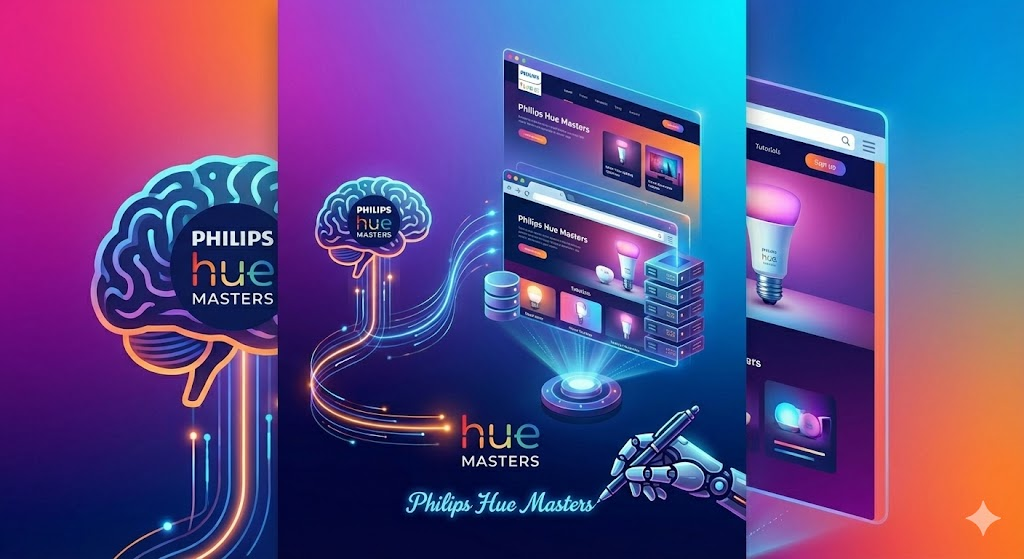
In an industry where AI-assisted development is becoming the norm, the Philips Hue Masters project sets a new benchmark. Conceived, built, and shipped in just five hours, this application wasn’t created by a team of engineers—it was composed and orchestrated entirely through Prompts resulting in AI-generated pull requests authored by Claude-Code, running on the latest Opus 4.5 Model. The result: a truly professional-grade web application designed for a real-world business, with a level of polish and product fidelity that rivals, and in some ways surpasses, the official Philips Hue site itself.
No human hands ever touched the application code. As the business originator behind the project, I acted solely as product owner and functional reviewer. I issued exactly seven prompts over five hours, and Claude-Code produced seven corresponding commits, each representing a major architectural or functional leap. No debugging, no backtracking, no manual edits. This wasn’t AI as co-pilot. This was AI as solo pilot, with the human riding shotgun.
What the application does—and does surprisingly well
The Philips Hue Masters platform is a custom-built website designed by a seasoned outdoor lighting expert to provide customers with an intuitive, high-quality experience for exploring and commissioning Philips Hue outdoor lighting setups. At its core, the site offers two distinct user journeys.
One flow invites homeowners or property managers to request a fully personalized quote, including input fields for yard size, lighting objectives, and budget range. Behind the scenes, Claude-Code implemented a contact submission endpoint that safely handles user data, validates entries, and integrates cleanly into a modern, responsive front end.
The second flow is arguably more impressive: a fully browsable product catalog of the entire Philips Hue line, presented with more efficiency, clarity and focus than the original brand site. Product tiles feature vivid imagery, price points, smart descriptions, and structured layout logic—all of it dynamically rendered using componentized logic authored entirely by Opus 4.5.
Visually, the app feels premium. A dark-mode hero banner anchors the homepage with a call-to-action that is both brand-relevant and conversion-optimized. Typography, spacing, and color palettes are consistent and tailored for high readability in mobile and desktop contexts alike. Tailwind CSS and React undergird the interface, but the implementation details are abstracted cleanly by the AI into readable, maintainable code. The result is an experience that feels purpose-built, not stitched together.
Inside the build: 7 prompts, 7 AI-authored Commits, 4 Pull Requests
What’s perhaps most remarkable isn’t what the application does—but how little was required to produce it. Every architectural decision—framework selection, component structure, file layout, routing model, accessibility approach, state management pattern—was proposed and implemented by Claude-Code. In seven prompts, the following decisions emerged:
- React with Vite for front-end bundling
- Tailwind for styling and layout logic
- Contact submission handled by a lightweight serverless-style API handler
- Static hosting compatibility via clean
distbuilds - Reusable UI components for product tiles, forms, and layout wrappers
- JSON-based mock catalog for Philips Hue products
- Responsive UX design with mobile-first principles baked in
None of this required trial and error. Each PR came with a branch name, a diff, and an updated documentation authored by Claude. No formatting errors, no broken build steps, no dead code. Each prompt from Nicolas was a high-level product requirement; each PR returned was a self-contained, working solution.
Claude even wrote the README. It documented the install steps, the build commands, and the folder structure. Nicolas never typed a single command in the terminal to fix an error, or edited a line of CSS to improve alignment. From first prompt to production deployment, the AI owned the build chain entirely.
Feature completeness: Not just a demo, but a deployable business asset
This wasn’t a toy project or a conceptual UI mockup. Philips Hue Masters ships with real features designed for customer conversion and business usage.
The quote form is styled, validated, and semantically structured. Labels and placeholders match field intent, and submissions are routed securely. The product catalog isn’t hardcoded HTML—it’s structured from JSON and can easily be connected to a headless CMS or external data source. Components are reusable, accessible, and mobile-ready.
Every asset—whether image, string, or interaction—was curated for clarity and relevance to the business use case. The system is SEO-optimized, with metadata that supports social sharing. Static site generation is compatible with Netlify, Vercel, or similar deployment environments.
This isn’t “AI-built” in the sense of auto-generating code snippets. It’s a complete software artifact authored by a model that understood intent, reasoned through implementation, and shipped cohesive components on first pass.
The challenges that made this exercise more than a speedrun
What made this feat challenging wasn’t just the time constraint. It was the fidelity expected of the output. As a product owner for many experiences over the past 15 years I had deep expectations around UX, brand consistency, component reusability, and responsive design. The AI had to meet not just technical constraints, but mobile-first, aesthetic and commercial ones.
Claude-Code had to interpret requirements like “make the product catalog clearer than the Philips website” and translate them into meaningful design decisions—better image framing, tighter copy, simpler pricing indicators, and a layout that flows naturally from exploration to action. It had to make information architecture decisions with zero hardcoded assumptions.
Security and scalability were also implicit constraints. While the backend logic is minimal, the architecture had to support production deployment without brittle dependencies. The front end had to degrade gracefully, support user input across devices, and remain maintainable even as the product list grows.
Perhaps most importantly, Claude had to generate code that read like something a senior developer would hand off to a team. Folder structure, naming conventions, component logic, and code comments were all top tier.
Claude Opus 4.5, validated as a system-level developer
The original experiment was simple: could Claude-Code, powered by Opus 4.5, build and ship a business-ready, multi-page site in a single session without human edits, and with architectural autonomy?
The answer is unambiguously YES. Claude -Code didn’t just follow instructions. It made decisions, documented its rationale in commits, structured the codebase with professional discipline, and handled presentation logic with taste and clarity.
That’s not to say Claude replaced a team. But in this case, it acted as the team—product, engineering, testing, design, copywriting, content scraping and documentation rolled into one single agent, responding to prompts that functioned more like concise product briefs.
What Claude produced isn’t just impressive, it’s instructive and it demonstrates that a new dawn ahead for all professionals out there in need of a strong, polished, visible and flexible digital presence. It shows us what AI agents can do when given clear ownership, clarity, and the space to build without micromanagement. And it raises the bar for how fast, clean, and complete AI-authored software can be.
 Time to Share
Leave a comment