
When I read about recent debate at the Federal Reserve about AI’s impact on productivity, inflation, and the labor market, one thought hit me immediately:
They’re asking the right questions.
But most companies are still acting too slowly.
The Fed is trying to determine whether AI is a cyclical productivity boost or a structural shift in economic capacity. That’s an economist’s lens. Fair enough.
From where I sit — building companies, training technologists, rescuing broken digital transformations — this is not a marginal upgrade.
It’s a big reset.
We’ve seen this before. Desktop. Web. Cloud. Mobile but AI is much much bigger.
And this time, it’s not just infrastructure. It’s cognition.
AI Is Not a Feature. It’s a Force Multiplier.
If AI meaningfully increases productivity across sectors, it will:
Lower marginal costs Compress time-to-market Increase output per employee Reshape wage dynamics Reprice talent
That’s not theory. We’re already seeing it live inside companies.
At CodeBoxx, our teams augmented with AI tools are shipping MVPs in weeks that used to take quarters. Debug cycles that once required days now collapse into minutes. Architecture decisions are simulated, tested, refined in real time.
That changes cost curves.
It changes velocity.
It changes who wins.
The Fed is debating when the data will prove it.
We’re already operating inside it.
Five Data Points showing this shift is inevitable
If you believe this is hype, look at the numbers.
Here are five verified signals that justify our decision to go all-in on AI:
1. McKinsey: $2.6–$4.4 Trillion in Annual Economic Impact
McKinsey & Company estimates generative AI could add between $2.6 trillion and $4.4 trillion annually to the global economy.
That’s not incremental improvement. That’s GDP-level impact.
2. Goldman Sachs: 300 Million Jobs Exposed to Automation
Goldman Sachs projects 300 million full-time jobs globally are exposed to automation through AI.
Exposure does not mean elimination. It means transformation.
And transformation demands retraining at scale.
3. PwC: AI Could Boost Global GDP by 14% by 2030
PwC estimates AI could increase global GDP by 14% (≈$15.7 trillion) by 2030.
If that materializes even halfway, it reshapes productivity, pricing power, and competitive advantage.
4. Stanford AI Index: Enterprise Adoption Is Accelerating
Stanford University’s AI Index shows enterprise AI adoption more than doubled in the past few years.
This is no longer experimental. It’s operational.
5. OpenAI: 100+ Million Weekly Users
OpenAI reports over 100 million weekly active users on its platforms.
Adoption velocity like that compresses diffusion timelines. Technologies that once took a decade now take quarters.
The Real Question isn’t productivity : It’s Readiness
The Fed is debating whether AI productivity gains will offset inflationary pressure.
But inside companies, the more urgent question is:
Are your people equipped to use this leverage?
Because AI doesn’t automatically create value.
Humans do.
AI amplifies the operator.
A mediocre team with AI is still mediocre but just acts faster and the damage will be tremendously amplified.
A well-trained, conscious, business-first, AI-native team takes an idea or a problem to exponential heights.
That’s the difference.
Why I’m Going All-In
Everyone at CodeBoxx and myself didn’t adopt AI defensively. We embraced it as a renewed purpose for our company.
We rebuilt our curriculum around AI-native development. Committed to the tools we believe will take part in getting the most positive progress throughout this paradigm shift in technology professional roles and skills sets.
We trained technologists to orchestrate models, not fear them. And we built tools of our own on top of those models. LLMs are the engines, Tokens are the fuel, Codex and Claude-Code are the Cars and we Built Crew-Kit to augment this foundation with rocket boosters and fully autonomous self-driving abilities.
We turned our digital agency into a live lab for real-world AI deployment.
Our graduates are not threatened by AI.
They are augmented by it.
That’s a strategic decision.
Because if 30–50% productivity gains materialize in certain functions, the labor market will not reward slow adapters.
It will reward those who can:
Define intent clearly Structure data intelligently Prompt precisely Validate critically Ship relentlessly
That is the new full stack.
Human + Machine + Business Outcome.
Inflation, Wages and the Invisible Variables
There’s something economists often miss.
AI doesn’t just affect output.
It affects expectations.
If customers expect faster delivery, smarter systems, personalized experiences and if competitors can provide them at lower cost, pricing power shifts.
Margin compresses for the slow and expands for the fast. AI will not eliminate inflation pressures overnight.
But it will separate efficient operators from inefficient ones and in a high-rate environment, efficiency wins.
The Risk Here is not Moving too Fast… It’s Leaders Moving too Slow
Every transformation cycle creates two camps:
Those waiting for certainty Those building through ambiguity
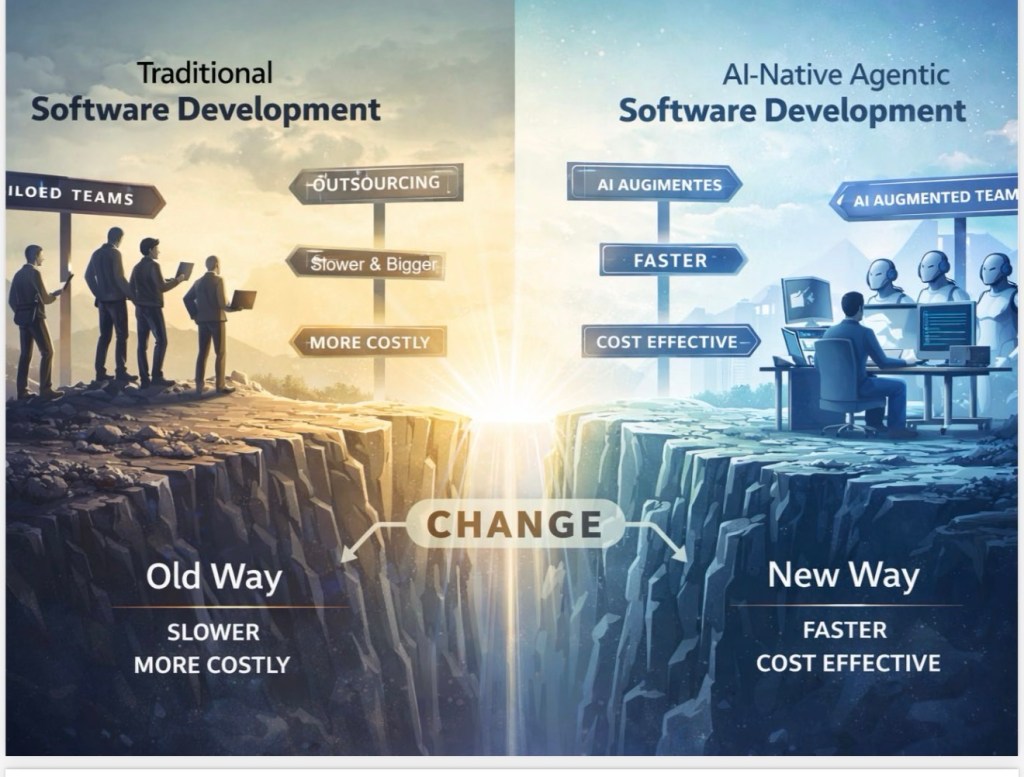
When cloud computing emerged, some debated security risks for years.
Others built AWS-native companies and won entire markets.
AI is the same pattern.
Except this time, the slope of the curve is steeper.
AI is a Moral Choice Too
This isn’t just economics.
It’s responsibility.
If 300 million jobs are exposed, then reskilling is not optional. If productivity rises, access must rise with it.
While growing CodeBoxx, I always believed that intelligence is evenly distributed but opportunity is not.
AI gives us an unprecedented chance to rebalance that equation.
But only if we train people fast enough.
Only if we build systems with intent.
Only if we choose augmentation over replacement.
The Fed is Catching Up
Eventually, the macro data will reflect the micro reality.
Productivity will show up in the numbers.
Margins will expand in AI-augmented firms.
Labor markets will bifurcate.
But by the time the debate ends, the winners will already be positioned.
AI is not a speculative variable anymore.
It’s an operational one.
The companies that treat it as an experiment will fall behind.
The ones that treat it as infrastructure will redefine their industries.
References in this Post
McKinsey & Company – The economic potential of generative AI (2023)
Goldman Sachs – The potentially large effects of artificial intelligence on economic growth (2023)
PwC – Sizing the Prize: What’s the real value of AI for your business?
Stanford University – AI Index Report
OpenAI – Public usage disclosures
 Time to Share
Leave a comment